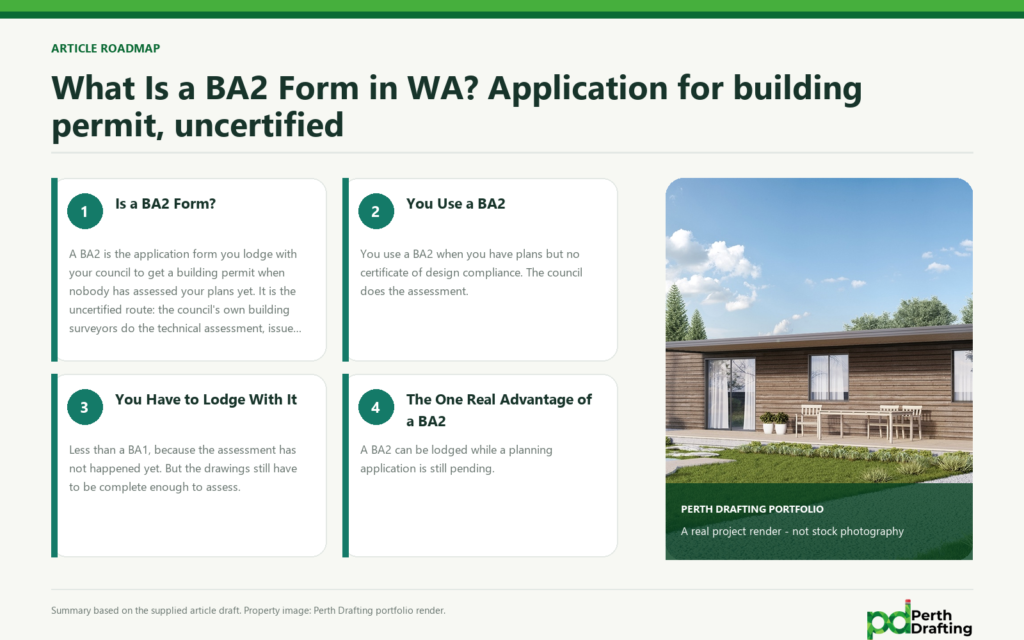
A BA2 is the application form you lodge with your council to get a building permit and council approval when nobody has assessed your plans yet. It is the uncertified route: the council’s own building surveyors do the technical assessment, issue the certificate of design compliance, and then issue the permit. It costs more in council fees than the certified route and takes longer.
The BA2 is one of a series of forms approved by the Building Commissioner under the Building Act 2011 and the Building Regulations 2012. You can tell you have the current version by the “Building Commissioner Approved” line and date in the footer.
When You Use a BA2
You use a BA2 when you have plans but no certificate of design compliance. The council does the assessment.
For a straightforward project on a normal lot, this is the ordinary route and there is nothing wrong with it. Where it starts to cost you is on anything with a variation or an unusual detail, because you find out what a surveyor thinks only after your council already has the file.
If a private building surveyor has already assessed your plans, you want the BA1 form instead.
What You Have to Lodge With It
Less than a BA1, because the assessment has not happened yet. But the drawings still have to be complete enough to assess.
- the drawing set: site plan at 1:200, floor plan and elevations at 1:100, construction details at 1:50
- structural engineering
- an energy assessment, for habitable buildings
- a Bushfire Attack Level report, where the lot is bushfire prone
- the prescribed application fee and the Building Services Levy
- builder’s details, or owner-builder approval
- the estimated value of the work, including GST
- all owners’ signatures
- planning approval, if it has been issued
The One Real Advantage of a BA2
A BA2 can be lodged while a planning application is still pending.
The council will place it on hold until the planning approval issues, but you are in the queue. A certified BA1 cannot be lodged at all until every prior approval is in hand.
On a job where planning and building are both needed and time matters, that is worth knowing. It does not make the assessment start any sooner, but it removes a handover step at the end.
What It Costs
The application fee is prescribed by regulation and is the same at every council.
| Fee | |
| Uncertified application, any class | 0.32% of the value of the work, minimum $121 |
Plus the Building Services Levy: 0.137% of the value where the work is over $45,000, or $61.65 where it is $45,000 or less.
Compare that to certified. A certified Class 1 or Class 10 application is 0.19%. Uncertified is 0.32%, which is roughly 70 per cent more in council fees.
What you avoid is the private building surveyor’s fee, which on a certified application you pay separately. On a small job that trade usually works out cheaper. On a larger one, run the numbers before assuming it does.
How Long a BA2 Takes
Councils typically determine an uncertified application in 25 working days, against 10 for a certified one, because their surveyors are doing the assessment from scratch.
Where the council needs further information you generally have 21 calendar days to provide it, and they then have the balance of their period. Miss it and the application can be refused.
Realistically, budget five weeks rather than two, and longer if anything comes back.
Where BA2 Applications Come Unstuck
The council is assessing your drawings cold, so gaps that a private surveyor would have raised in a phone call become formal requests for further information instead.
The usual ones: no footing or tie-down detail, setbacks not dimensioned, no levels, a manufacturer’s specification with nothing marked, and an energy report that does not match the drawings.
Each one costs two to three weeks.
Where the BA2 Sits in the Process
- Design and drawings prepared
- Planning approval, where required. See council approval
- Building surveyor assessment and certificate of design compliance
- Building permit application lodged with your council
- Permit issued, work commences
- Notice of completion lodged when finished
Full detail on the permit itself: building permits
The Other Forms You Might Meet
| Form | What it is |
| BA1 | Application for building permit, certified |
| BA2 | Application for building permit, uncertified |
| BA3 | Certificate of design compliance |
| BA5 | Application for demolition permit |
| BA7 | Notice of completion |
| BA8 | Notice of cessation |
| BA9 | Application for occupancy permit |
| BA13 | Application for building approval certificate |
| BA17 | Certificate of construction compliance |
| BA18 | Certificate of building compliance |
| BA19 | Request to amend building permit or builder’s details |
| BA20 | Notice and request for consent to encroach or adversely affect |
| BA22 | Application to extend time, building or demolition permit |
| BA23 | Application to extend time, occupancy permit or building approval certificate |
Also see the BA1 form , the BA3 form, certificates of design compliance.
BA2 Questions
What is a BA2 form?
The application form for an uncertified building permit, lodged with your local government where the council’s own building surveyors will assess the plans.
How much does a BA2 cost?
The prescribed fee is 0.32% of the value of the work with a $121 minimum, plus the Building Services Levy. There is no separate surveyor fee.
How long does a BA2 take?
Councils typically determine uncertified applications in 25 working days from a complete lodgement, against 10 for certified.
Can I lodge a BA2 before planning approval?
Yes. It will be placed on hold until the planning approval issues, but you can lodge. A certified BA1 cannot.
Is a BA2 cheaper than a BA1?
In council fees, no. Uncertified is 0.32% against 0.19% certified. What you avoid is paying a private building surveyor separately, which on a small job usually nets out cheaper.
Which is better, BA1 or BA2?
BA2 for a straightforward job on a normal lot. BA1 where there is a variation, a boundary question or an unusual detail, because you get a surveyor’s view before the council has your file.
General guidance only, current at Sept 2026. Forms and prescribed fees are set under the Building Act 2011 and Building Regulations 2012 and change from time to time. Always download the current form from the WA Government and confirm fees with your local government.