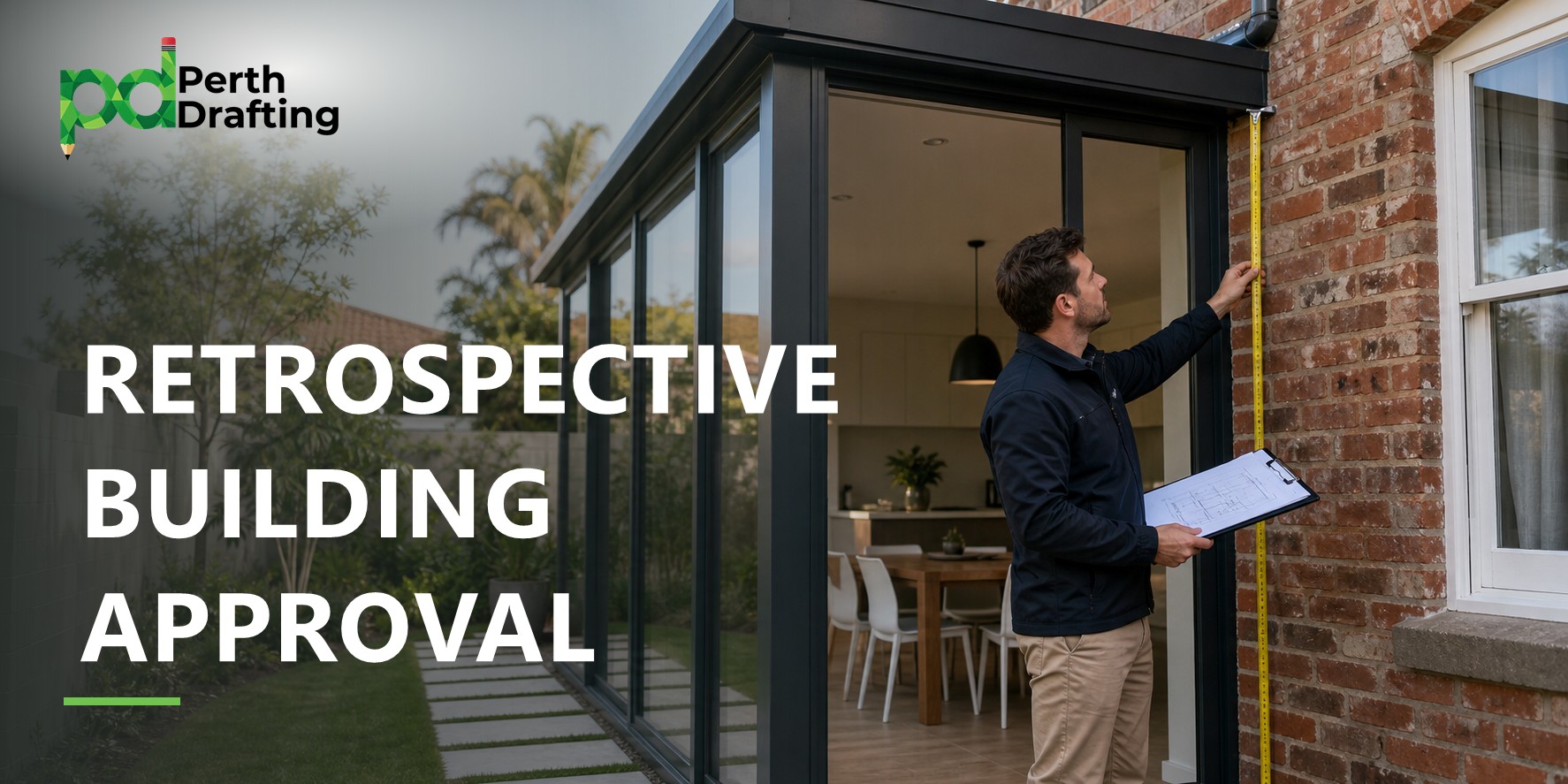
A retrospective building approval is approval obtained after building work has already been started or completed without the required permit, to confirm the work complies with applicable building standards.
Can You Get Retrospective Building Approval in WA?
Usually. A registered building surveyor inspects the work and, if it complies with the applicable building standards, issues a certificate of building compliance on form BA18. You then apply to your council for a building approval certificate on form BA13. Where planning approval is also required it must be obtained first. Most work that was built sensibly gets through.
The Two Certificates You Need
BA18, certificate of building compliance. Signed by a registered building surveyor, certifying that the existing building complies with the applicable building standards. This is the hard part.
BA13, application for building approval certificate. Lodged with your council with the BA18 attached. This is the paperwork part.
For Class 1 and Class 10 buildings, houses and residential structures, a building approval certificate is what you are after. For Class 2 to Class 9 buildings it is an occupancy permit on form BA9 instead.
What It Costs, and Why It Costs More
The penalty is in the prescribed fees, and it is substantial.
| Application | Prescribed fee |
| Building approval certificate, existing building, no unauthorised work | $121 flat |
| Building approval certificate, unauthorised work | 0.38% of the value of the work, min $121 |
| Occupancy permit, unauthorised work | 0.18% of the value, min $121 |
And the Building Services Levy doubles:
| Over $45,000 | $45,000 or less | |
| Approved work | $61.65 | $61.65 |
| Unauthorised work | 0.274% of the value | $123.30 |
Compare 0.38% for unauthorised work against 0.19% for a certified building permit on approved work. The statutory fee for fixing it afterwards is double what it would have cost to do it properly, and that is before the doubled levy on top.
Note also how the value is assessed: for unauthorised work it is the current value of the work as determined by the permit authority, not what you paid at the time. If you built it cheaply in 2015 that does not help you in 2026.
Councils frequently add their own penalty loading on the planning side as well. Some charge three times the standard development application fee.
Where the Money Actually Goes
The statutory fees are not usually the biggest number. These are:
| What | Rough guide |
| Drafting the as-built work | from $750 + GST for a simple structure, more for a dwelling |
| Building surveyor, BA18 | quoted per job, higher than a standard certificate because it includes a site inspection |
| Structural engineer’s certificate | quoted per job |
| Regulation 25a survey certificate, where the structure is near a boundary | varies |
| Rectification work | whatever it takes |
How the Process Works
Step 1: measure and draw what is actually there
Not what was intended. What was built.
We measure on site and draw it exactly as it stands, to the standard a new application would need. This step finds the surprises, because structures drift during construction and nobody updates a drawing that never existed.
Step 2: check it against both rule sets
Planning. Setbacks, height, size, open space, and whether the property still complies overall.
Building. The National Construction Code as it applies to the structure: structural adequacy, fire separation, damp, and for habitable buildings the full amenity provisions.
Step 3: the building surveyor inspection
An independent registered building surveyor inspects and, if satisfied, issues the BA18.
Expect to be asked to expose something. Footings are the usual one. On a habitable building, wet areas and services are the harder ones, because the work is concealed and has to be evidenced.
Step 4: lodge the BA13
With the BA18, the referenced plans and specifications, evidence of any council planning approval, the structural engineer’s certificate, a Regulation 25a survey certificate where required, and the fees and levies.
If the work encroaches on or adversely affects neighbouring land, you also need evidence of consent from that owner, which has its own form.
The Problem That Actually Stops Retrospective Approvals
Not the drawings. Not the setbacks. Certificates that no longer exist.
Electrical, plumbing, gas and waterproofing work has to be certified by the person who did it. Where that work was done without certification, or by somebody unlicensed, or by somebody who has since disappeared, those certificates cannot be issued retrospectively by anyone else.
A surveyor may then require sections to be opened up, tested, or redone. On a habitable building that is frequently the item that decides whether the project is worth pursuing.
This is why an unapproved patio is usually straightforward and an unapproved granny flat often is not.
What If It Does Not Comply?
Modify it. Usually the cheapest answer, and often smaller than people fear.
Move it. Available for some structures and not others. A bolted-down shed can shift. A slab-on-ground extension cannot.
Argue it. Where the failure is planning rather than building, the design principles pathway lets you justify the departure in writing. See justification letters.
Remove it. The last resort, and genuinely rare.
If a council does move to enforcement there is time built into the process. Typically 14 days’ notice of intent to issue a building order, then 28 days to comply once issued, with a right of review to the State Administrative Tribunal within 28 days.
Councils generally work toward compliance first. Removal is where compliance cannot be achieved, not where somebody is annoyed.
How People Find Out
Selling the house. The most common by a distance. The buyer’s settlement agent asks the council for approvals, nothing is on file, and it lands mid-settlement on a date you do not control.
An insurance claim. The insurer asks for the building approval.
Aerial imagery. Councils compare dated photography.
A neighbour.
You bought it that way. Unapproved work transfers with the property.
Retrospective Approval by Structure
The process is the same. The difficulty is not.
| What | Typical difficulty |
| Patio | Usually straightforward |
| Shed | Usually straightforward, and it can often be moved |
| Carport | Harder if forward of the building line, because it breaches streetscape provisions |
| Granny flat | Hardest. Habitable, so the full code applies, and services certificates are usually the obstacle |
| Extension | Depends entirely on how it was built |
How Long It Takes
Two weeks in our queue, then one to three weeks to draw depending on the structure. The surveyor’s inspection on top, then the council.
Realistically six to sixteen weeks, and longer where anything needs opening up or rectifying.
If you are in a settlement, say so on the first call. It changes how we sequence everything.
Retrospective Approval Questions
Can I get retrospective approval for unauthorised building work?
Usually, where the work complies with the applicable building standards. The route is a BA18 certificate of building compliance from a registered building surveyor, then a BA13 building approval certificate from your council.
How much does retrospective approval cost in WA?
The prescribed council fee for a building approval certificate for unauthorised work is 0.38% of the value of the work, against $121 flat where no unauthorised work was done. The Building Services Levy also doubles, to 0.274% above $45,000. Consultants and any rectification sit on top.
Will I be fined for unauthorised building work?
Commencing building work without a permit is an offence under section 9 of the Building Act 2011, so the possibility exists. In practice councils pursue compliance, and the cost most owners meet is the penalty loading on the fees rather than a prosecution.
What is a BA18?
The certificate of building compliance, signed by a registered building surveyor, certifying that an existing building complies with the applicable building standards. Without one you cannot apply for a building approval certificate.
I bought a property with unapproved work. Is it my problem?
Yes. It transfers with the property, and it is far better dealt with while you own it than during a sale.
Can the council make me demolish it?
Only where compliance cannot be achieved. Councils generally work toward compliance first. If a building order is issued there is 14 days’ notice of intent and 28 days to comply, with a right of review to the State Administrative Tribunal.
How is the value of unauthorised work assessed?
As the current value of the work, determined by the permit authority. Not what it cost you at the time.